
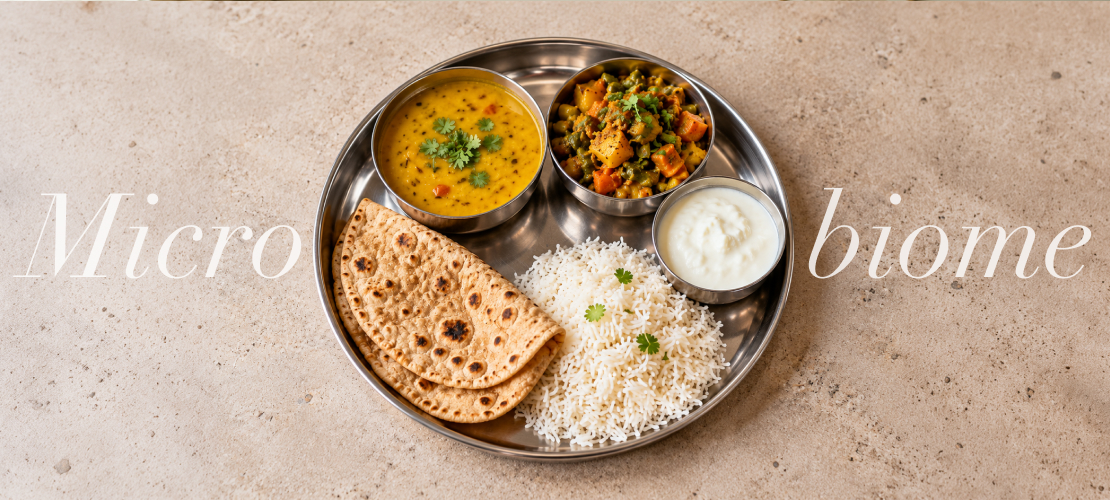
Most gut health advice comes from studies of people in the US and Europe. Their meals look nothing like roti, dal, sabzi and dahi, and their gut bacteria differ too.
That matters when you judge your own gut. This guide explains what a healthy gut microbiome looks like, how the Indian gut differs, and how a gut microbiome test can show where you stand.
What Is a Healthy Gut Microbiome?

A healthy gut microbiome is a large, varied and stable community of bacteria and other microbes in your large intestine. It digests fibre your body cannot, produces short-chain fatty acids, protects the gut lining and returns to balance after an illness or a course of antibiotics.
There is no single ideal microbiome, and two healthy people can carry very different bacteria. Scientists look for shared features instead:
- Diversity: Many species, so no single group takes over.
- Function: Steady production of short-chain fatty acids (SCFAs) from fibre.
- Resilience: Recovery after antibiotics or food poisoning.
- A Strong Gut Lining: Support for the mucus layer and the seals between gut cells.
New to the topic? Start with our guide to how your gut microbiome works.
Diversity: Why More Species Is Better
Diversity means how many different microbial species live in your gut and how evenly they are spread. Higher diversity is linked with better metabolic health. Low diversity is more common in people with obesity and inflammatory bowel disease. A varied diet is one of its strongest drivers.
In the American Gut Project, people who ate 30 or more types of plants a week had more diverse gut bacteria than those who ate 10 or fewer. A home-cooked thali with dal, sabzi, grains, chutney and spices covers several plant types in a single meal.
Keystone Species: The Bacteria Others Depend On
Keystone species are bacteria whose work supports many others:
- Ruminococcus bromii breaks down resistant starch so other microbes can use it.
- Faecalibacterium prausnitzii is a major butyrate producer.
- Akkermansia muciniphila lives in and maintains the protective mucus layer.
Losing them affects the whole community and alters microbial equilibrium.
SCFAs and Butyrate: What Healthy Bacteria Make
When gut bacteria ferment fibre, they make short-chain fatty acids: acetate, propionate and butyrate. Butyrate is the primary fuel for the cells lining your colon. SCFAs also help keep the gut lining tight, calm inflammation and send signals to the brain through the gut-brain axis.
That is one reason gut health can affect mood and sleep, as our gut-brain axis explainer shows. Researchers also measure zonulin, a protein that loosens the seals between gut cells, as a marker of a leaky lining, though its value as a routine standalone test is debated.
Is the Indian Gut Microbiome Different?
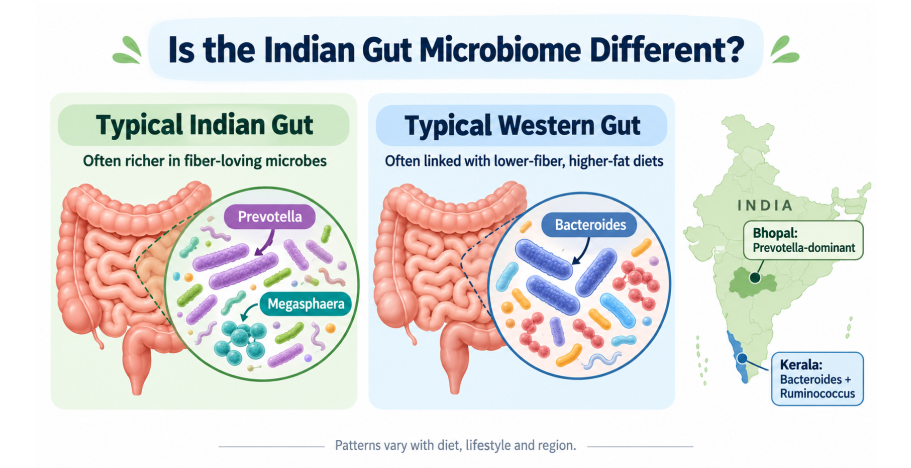
Yes. Studies of healthy Indian adults find a gut microbiome rich in Prevotella, with more Megasphaera and Lactobacillusthan American samples. Researchers link this to India's plant-heavy, high-fibre diet and fermented foods. The pattern also shifts by region and by whether people eat meat.
A 2016 study in Frontiers in Microbiology compared healthy Indians with people from the US, Korea, Spain and Bangladesh. Indian guts differed from American ones, resembled Bangladeshi guts and stood out for high Prevotella and Megasphaera, a genus that turns lactate into SCFAs.
A 2019 study of 110 healthy adults showed how diet and region change the picture:
- In Bhopal: Where diets were mostly plant-based, Prevotella dominated.
- In Kerala: Where people ate more fish and meat, Bacteroides, Ruminococcus and Faecalibacterium were more abundant.
Why Prevotella Matters
Prevotella bacteria specialise in breaking down complex plant fibres from grains, legumes and vegetables. A Prevotella-rich gut is typical of traditional, high-fibre diets around the world. For most Indians, a high Prevotella level is normal and simply reflects a fibre-rich diet.
In a Swedish study, people whose blood sugar control improved after three days of barley bread had more Prevotella copri. Prevotella is not automatically good in all contexts, though; some strains are linked to inflammation in rheumatoid arthritis, so balance matters more than any single genus.
Why Western “Good Bacteria” Lists Can Mislead
Most rankings of good and bad gut bacteria are built on Western volunteers. Measured against those references, a normal Indian gut with plenty of Prevotella and fewer Bacteroides can look unusual, even when the person is healthy and eating a traditional, fibre-rich diet.
The largest such ranking, published in Naturein 2025, studied more than 34,000 people, mainly from the UK and US, and named 50 species linked to better health and 50 to worse. The 2016 Indian study's authors made a related point: India needs its own markers of a healthy gut.
Signs Your Gut Microbiome Is in Good Shape
A healthy gut usually shows up as regular, comfortable bowel movements, little bloating, steady energy after meals and the ability to eat a wide range of foods without trouble. These signs are useful clues, but they cannot tell you which specific bacteria you carry:
- Bowel movements anywhere from three times a day to three times a week, without straining
- Soft, formed stools (types 3 to 4 on the Bristol Stool Chart)
- Gas and bloating that are mild and pass quickly
- No regular heartburn, cramps or urgency after meals
Ongoing bloating, irregular stools, tiredness or skin flare-ups can point the other way, towards dysbiosis—an imbalance in gut bacteria. Blood in your stool, unexplained weight loss or pain that wakes you at night needs a doctor's review before any diet change.
How to Build a Healthy Gut on an Indian Diet
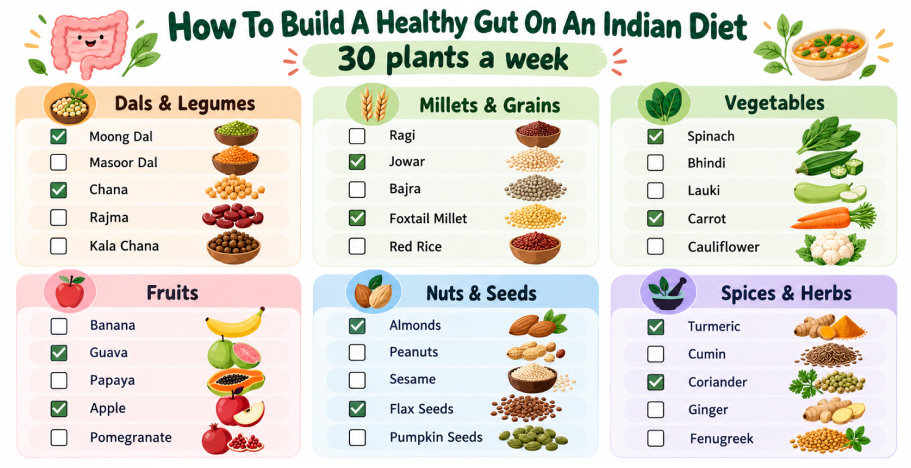
Feed your gut bacteria a wide variety of plant fibre, add fermented foods daily and cut back on ultra-processed snacks. Traditional Indian meals already do much of this. Aim for variety across the week rather than one superfood:
- Rotate Dals and Legumes: Moong, masoor, chana, rajma and lobia each bring different fibres. Soak and pressure-cook them for easier digestion.
- Mix Your Grains: Swap some wheat or white rice for bajra, jowar or ragi. Rice cooked and then cooled forms resistant starch, which butyrate producers feed on.
- Have Fermented Foods Daily: Dahi, chaas and kanji carry live beneficial bacteria. Idli and dosa are fermented, making them light and digestive-friendly. See our list of fermented foods to add to your diet.
- Count Your Plants: Vegetables, fruits, nuts, seeds and spices such as haldi and jeera all count towards 30 a week. Our guide to fibre-rich foods has practical ideas.
- Limit Packaged Namkeen and Sugary Drinks: They are low in fibre, and artificial emulsifiers have been observed damaging the gut mucus layer in research.
How Can You Find Out What Your Gut Looks Like?
Symptoms only tell part of the story. A gut microbiome test reads the bacterial DNA in a stool sample to show which bacteria you carry and how diverse they are. With that profile, diet changes can target your own gut instead of following general advice written for someone else.
See what your own gut looks like. Bione's Gut Microbiome Test uses an at-home stool kit and 16S sequencing to map your gut bacteria. Your report includes a Gut Health Score, foods to eat and limit, and a diet plan built around Indian foods. Book your test today.
References
- Bhute S, Pande P, Shetty SA, et al. Molecular characterisation and meta-analysis of gut microbial communities illustrate enrichment of Prevotella and Megasphaera in Indian subjects. Frontiers in Microbiology. 2016;7:660.
- Dhakan DB, Maji A, Sharma AK, et al. The unique composition of Indian gut microbiome, gene catalogue, and associated faecal metabolome deciphered using multi-omics approaches. GigaScience. 2019;8(3):giz004.
- Asnicar F, et al. Gut micro-organisms associated with health, nutrition and dietary interventions. Nature. 2025.
- McDonald D, Hyde E, Debelius JW, et al. American Gut: an open platform for citizen science microbiome research. mSystems. 2018;3(3):e00031-18.
- Kovatcheva-Datchary P, Nilsson A, Akrami R, et al. Dietary fibre-induced improvement in glucose metabolism is associated with increased abundance of Prevotella. Cell Metabolism. 2015;22(6):971-982.
- Scher JU, Sczesnak A, Longman RS, et al. Expansion of intestinal Prevotella copri correlates with enhanced susceptibility to arthritis. eLife. 2013;2:e01202.
Medical disclaimer: This article is for general information only and does not replace advice from a qualified doctor or nutritionist.
Frequently Asked Questions
Yes. A gut microbiome test shows which bacteria are high or low in your gut, and the report can turn that into food choices. Bione's report includes foods that suit your gut, foods to limit and a personalised Indian diet chart based on your results.