
In many Indian homes, a spoon of ghee is treated as medicine for the stomach. Wellness posts now credit that to butyrate, a compound ghee contains.
Butyrate does matter for your gut. Most of the butyrate your colon uses, though, is made inside it by bacteria feeding on fibre. This guide explains how that works, where ghee fits, and how a gut health test can show whether butyrate-making bacteria are doing well in your gut.
What Are Short-Chain Fatty Acids?
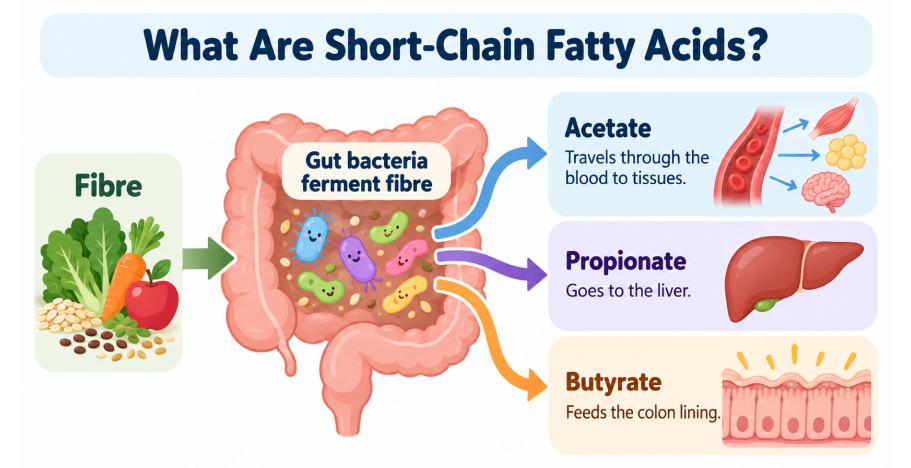
Short-chain fatty acids (SCFAs) are small fats that gut bacteria produce when they ferment fibre your body cannot digest. The three main ones are acetate, propionate and butyrate. Most are made in the colon, where they feed the gut lining and send signals around the body.
Each one has a different job:
- Acetate: The most plentiful SCFA, which travels through the blood to other tissues.
- Propionate: Mostly taken up by the liver, where it is linked to glucose and cholesterol control.
- Butyrate: Mostly used up by the cells of the colon wall itself.
Steady SCFA production is one of the signs of a healthy gut microbiome, alongside diversity and a strong gut lining.
What Does Butyrate Do for Your Gut?
Butyrate is the main fuel for the cells lining your colon, supplying around 70% of their energy. It also helps seal the gut barrier, calms inflammation and keeps the colon low in oxygen, which favours helpful bacteria over harmful ones:
- Feeds the colon lining: Colon cells take up butyrate first, before it reaches the bloodstream.
- Seals the barrier: It supports the tight junctions that hold gut cells together.
- Calms inflammation: In mice, butyrate increased regulatory T cells, the immune cells that dampen inflammation.
- Limits harmful bacteria: Colon cells that burn butyrate use up oxygen, which limits microbes that thrive on it, such as some E. coli strains.
Much of this evidence comes from lab and animal research. Human studies support the overall picture, especially butyrate's role as colon fuel.
Which Bacteria Make Butyrate?
A small group of colon bacteria makes most of your butyrate, including Faecalibacterium prausnitzii, Roseburia and Eubacterium rectale. Other bacteria help by breaking fibre down first or making acetate and lactate, which the butyrate makers then convert. This teamwork depends on a regular supply of fibre.
People with inflammatory bowel disease and type 2 diabetes often carry fewer of these bacteria. A drop in butyrate producers is one feature of dysbiosis, an imbalance in gut bacteria.
Is Ghee Good for Gut Health?
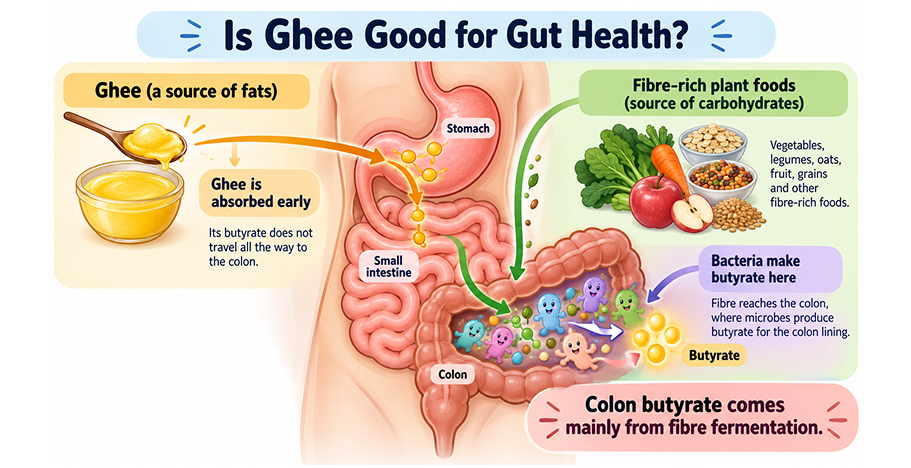
Ghee is a fine cooking fat in small amounts, but it is not a major source of butyrate for your colon. It contains a little butyric acid, and most of that is absorbed in the stomach and small intestine. The butyrate your colon runs on comes mainly from fibre.
How Much Butyrate Is in Ghee?
Butter contains roughly 3 g of butyric acid per 100 g, and ghee, which is almost pure milk fat, holds a similar amount. A teaspoon of ghee weighs about 5 g, so it carries roughly 0.1 to 0.2 g, locked inside fat molecules.
Digestive enzymes in the stomach and small intestine release that butyrate early, and the body absorbs it there. A 2022 review in Frontiers in Nutrition notes that this is why butyrate products are often bound to fibre or made as tributyrin, to stop them being absorbed too soon.
Where Ghee Does Fit
Ghee still has a place in a gut-friendly Indian kitchen. It has almost no lactose, adds flavour to fibre-rich dals, sabzis and millet rotis, and helps you absorb fat-soluble vitamins. About 60% of ghee is saturated fat, so ICMR-NIN's guidance to use fats in moderation applies.
A spoon of ghee on your dal is fine. The dal is what feeds your butyrate producers.
Indian Foods That Help Your Gut Make More Butyrate
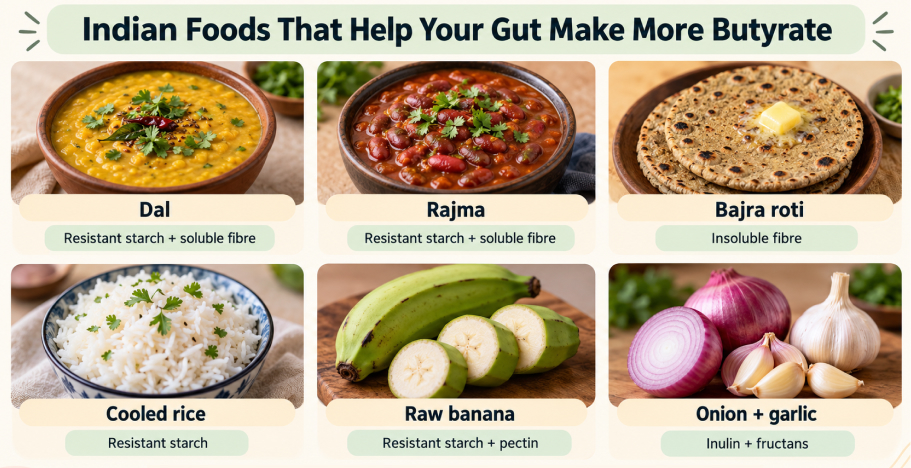
Your gut makes the most butyrate from resistant starch and fermentable fibres. Good Indian sources include dals and rajma, millets and whole grains, cooled rice, raw banana, onions and garlic. Variety matters because different bacteria prefer different fibres, so rotate these through the week:
- Pulses: Moong, masoor, chana and rajma bring resistant starch and fermentable sugars.
- Millets and Whole Grains: Bajra, jowar, ragi, jau (barley) and oats.
- Cooked and Cooled Starches: Rice and potatoes that are cooled after cooking form more resistant starch, and much of it stays even after reheating.
- Raw Banana: Kacha kela is one of the richest sources of resistant starch.
- Onion and Garlic: Both contain inulin-type fibres that gut bacteria ferment into SCFAs, including butyrate.
One caveat: isabgol helps form soft stools, but bacteria ferment it poorly, so it adds little butyrate. Our guide to fibre-rich foods has more options.
Very low-carb diets can work against this. In one study, adults on a low-carbohydrate diet had less butyrate and fewer butyrate-making bacteria in their stools. Our comparison of plant-based and keto diets covers the trade-offs.
Are Butyrate Supplements or Postbiotics Worth Taking?
Butyrate supplements, sold as sodium butyrate or tributyrin, have only small human studies behind them, mostly in IBS and inflammatory bowel disease. For most people, eating more fermentable fibre is the better-tested way to raise butyrate. Check with a doctor before starting any supplement.
These products are often marketed as postbiotics. Under the scientific definition from ISAPP, a postbiotic is a preparation of inactivated microbes or their parts, and purified compounds like butyrate should be called by their chemical names. For how these terms compare, read our guide to probiotics vs prebiotics.
How Can You Tell If Your Gut Makes Enough Butyrate?
Butyrate itself is rarely measured outside research labs. A gut microbiome test can show whether butyrate-making bacteria such as Faecalibacterium and Roseburia are well represented, and how diverse your gut is overall. That tells you whether your diet needs more of the right fibres.
Check whether your gut has the bacteria that make butyrate. Bione's Gut Microbiome Test uses an at-home stool kit and 16S sequencing to map your gut bacteria. Your report includes a Gut Health Score, foods to eat and limit, and a diet plan built around Indian foods. Book your test today.
Frequently Asked Questions
References
- Cleveland Clinic: Butyrate benefits. Link
- Two Brothers: Ghee for gut health. Link
- The Week: Does ghee help reduce inflammation? Link
- Mayorga-Ramos et al. Butyrate and the intestinal epithelial barrier: A systematic review. Frontiers in Nutrition. 2022. Link
- ISAPP consensus statement on the definition and scope of postbiotics. Link
- Roediger WE. Role of anaerobic bacteria in the metabolic welfare of the colonic mucosa in man. Gut. 1980;21(9):793-798. Link
Medical disclaimer: This article is for general information only and does not replace advice from a qualified doctor or nutritionist.