

PCOS prevalence in India runs from 3.7 to 22.5 percent of women depending on region and diagnostic criteria. Urban Mumbai studies using Rotterdam criteria found 22.5 percent; an adolescent study in Tamil Nadu found 18 percent. This is not a rare condition, and most Indian women managing it get the same three-line advice: lose weight, cut carbs, take metformin.
Gut health and PCOS is the newer conversation, and it is worth having provided nobody oversells it. Something real is happening in the research, and it is earlier-stage than the headlines suggest. This post gives you both.
The Insulin Resistance Bridge
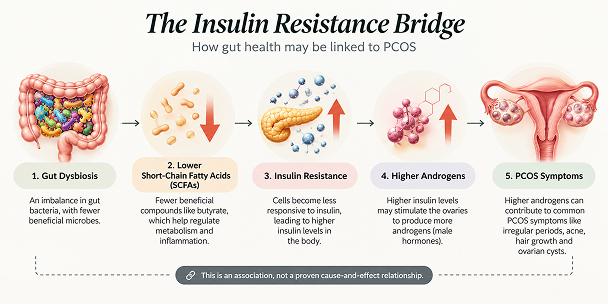
To understand why gut bacteria enter a hormonal conversation at all, start with insulin.
Insulin resistance sits underneath most PCOS. It affects the majority of women with the condition, including lean women, which is why the advice to simply lose weight misses so many people. When cells stop responding properly to insulin, the pancreas produces more of it. High circulating insulin pushes the ovaries to produce more androgens, and it lowers sex hormone binding globulin (SHBG), the protein that keeps testosterone bound and inactive. Less SHBG means more free testosterone, which drives the acne, the hair growth and the irregular cycles.
Gut bacteria influence that chain at its start. Bacteria that ferment fibre produce short-chain fatty acids (SCFAs), which improve insulin sensitivity and help maintain the gut barrier—a mechanism explained in detail in our guide on gut microbiome and weight gain. When those bacteria are depleted, two things follow: less of the compounds that help insulin work, and a weaker gut lining that lets bacterial fragments into circulation, driving the low-grade inflammation that worsens insulin resistance further.
That is the proposed mechanism linking gut bacteria and insulin resistance to PCOS, and it is the clearest route by which the gut microbiome and hormonal imbalance connect. It fits what we know about both systems, and it is still a mechanism rather than a proven pathway.
What the Research Actually Found
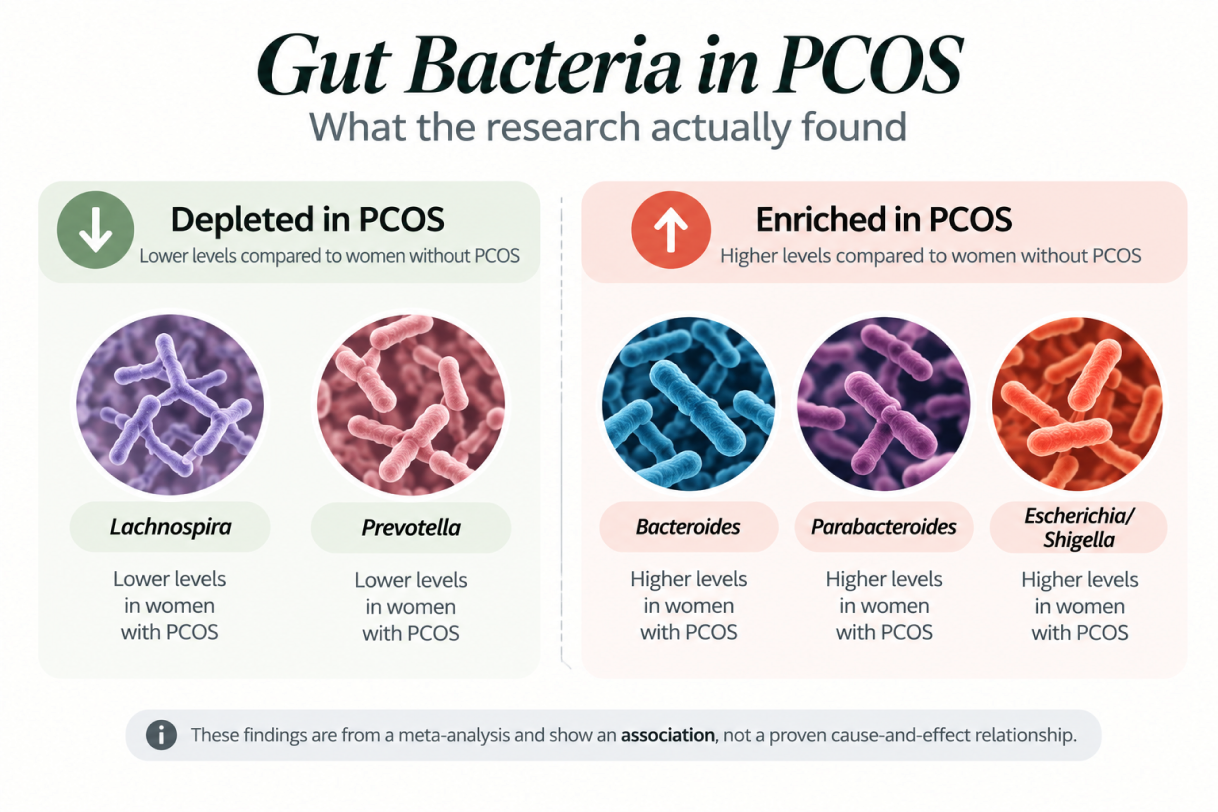
A systematic review and meta-analysis published in BMC Medicine pooled 28 studies covering 1,022 women with PCOS and 928 controls. Two findings stand out:
- Lower bacterial diversity: Women with PCOS had measurably lower gut bacterial diversity. The Shannon index difference was modest but consistent in direction across studies, as was phylogenetic diversity. Lower diversity is broadly associated with poorer metabolic health.
- Shift toward inflammatory species: The composition differed too. Lachnospira and Prevotella were depleted in PCOS, while Bacteroides, Parabacteroides, Escherichia/Shigella and others were enriched. The authors described the pattern as a reduction in short-chain fatty acid producing and bile acid metabolising bacteria, shifting the balance toward pro-inflammatory species. That maps neatly onto the insulin mechanism above.
Now the honest part. A separate systematic review that formally graded the evidence rated its quality as low for most studies, concluded that further research is needed to establish the interactions, and made no recommendation for clinical microbiome testing. A pattern of gut dysbiosis is well established, but direction of causation is not. It remains unclear how much of the dysbiosis drives PCOS versus reflects the insulin resistance and eating patterns that come with it.
Treat anyone claiming your gut bacteria caused your PCOS as ahead of the evidence.
Why the Indian Picture Differs
Two things make this more than an imported topic:
- Naturally Prevotella-rich microbiomes: Indian gut communities are naturally Prevotella-rich, a signature of high-fibre diets built on grains and dals. Prevotella is also one of the genera found depleted in PCOS. Practically, that means reference ranges built on European and American cohorts can misread an Indian gut in either direction, so personalized interpretation matters more here.
- Distinct metabolic thresholds:Indian women tend toward insulin resistance and central fat at lower BMIs than European women, which is why Indian guidelines treat a BMI of 23 as overweight rather than 25. A woman with PCOS at BMI 24 can be metabolically affected while a Western chart calls her healthy, and “lose weight first” lands badly on someone never classified as heavy.
Does Fixing the Gut Actually Help?
This is where the evidence gets more useful, because intervention trials test the idea directly rather than observing a correlation.
Randomised trials of probiotics and synbiotics in women with PCOS have shown improvements in insulin resistance, with reductions in HOMA-IR, fasting glucose and insulin. On the hormonal side, supplementation increased SHBG and reduced total testosterone, which is the direction you want. Effects on hirsutism specifically were not significant.
The caveats are substantial. The trials were small, ran only eight to twelve weeks for a condition managed over years, and were mostly conducted among overweight women, so transfer to lean Indian women is untested. Strains and doses varied too widely to compare cleanly. The reviewers called for larger, longer, multicentre trials before broad clinical use.
What this supports: gut-directed changes plausibly help the metabolic side of PCOS.
What it does not support: replacing your endocrinologist or gynecologist with a probiotic.
What an Indian PCOS Diet Should Be Built Around
Most PCOS diet advice in India collapses into “avoid rice and go low carb,” which is neither necessary nor sustainable in most Indian households. A gut-informed version looks different:
- Fibre variety, not just volume: Different bacteria ferment different fibres. Rotating dals, millets, vegetables and fruit builds the short-chain fatty acid producers that were depleted in the PCOS studies. This does more than doubling down on one high-fibre food, as detailed in our guide to prebiotics and probiotics.
- Protein and fat with your carbohydrates: Rice is not the enemy; rice alone on an empty stomach is the problem. Pairing it with dal, curd, vegetables or egg blunts the glucose spike and the insulin response that follows.
- Fermented foods daily: Curd, kanji, idli and dosa batter deliver live cultures at no extra cost. Adding traditional fermented foods is the simplest, most accessible daily intervention.
- Resistant starch:Rice and potato cooled after cooking form resistant starch that feeds butyrate producers. Yesterday’s rice is better for your gut than today’s.
- Managing digestive symptoms: A meaningful share of women with PCOS also experience IBS-type bloating or digestive distress. If bloating is severe, following a low FODMAP Indian diet temporarily can help pinpoint trigger foods.
- Sleep and stress: Both independently worsen insulin resistance and shift microbial composition, so in PCOS they are not a soft add-on to the diet advice.
None of this replaces medical management. Metformin, hormonal treatment and fertility care are decisions for your doctor, and nutrition works alongside them.
Where Testing Fits
General advice cannot tell you which of these applies to you, and with PCOS the variation between women is the whole challenge.
A gut health test does not diagnose PCOS. Diagnosis is clinical, based on cycles, androgen levels and ultrasound. What sequencing shows is your bacterial composition: whether your fibre fermenters are depleted, how your diversity sits, and whether a dysbiosis pattern is worth addressing alongside your treatment.
Bione’s PCOS Care Program is built for PCOS and PCOD, irregular cycles, stubborn weight and stress, combining the Gut Microbiome Test (with transparent pricing outlined in our test cost guide) with personalized PCOS nutrition from clinical specialists who work with Indian food rather than a Western template.
Want to understand your own gut before changing your diet? Explore the Bione PCOS Program or book a free consultation and select PCOS or irregular periods as your concern. Call +91 8147692743 (Mon to Sat, 10 AM to 6 PM) or email support@bione.in.
Conclusion
The link between gut health and PCOS is real, consistent across studies, and most likely runs through insulin resistance. It is also an association rather than proven cause, and the certainty of the evidence is currently rated low.
That combination justifies acting on your gut as part of managing PCOS. It does not justify treating your microbiome as the sole cause or the cure. Feed the bacteria that support insulin sensitivity, keep your medical care in place, and if you want specifics rather than general advice, test instead of guessing.
FAQs
Randomised trials show improvements in HOMA-IR, fasting insulin, SHBG and total testosterone. The trials were small, ran only eight to twelve weeks, and were mostly conducted among overweight women, so treat the results as promising rather than settled. Dietary fibre variety and fermented foods are a better starting point than a capsule.
No. PCOS is diagnosed clinically through cycle history, androgen levels and ultrasound. A gut microbiome test shows your bacterial composition and diversity, which can inform diet alongside your treatment, but it is not a diagnostic and no guideline recommends it for diagnosis.