

Akkermansia muciniphila went from an unknown gut microbe to a supplement-shelf name in about two decades. Most of the excitement traces back to mouse studies and one small human trial.
This guide covers what the research shows, what it does not, and which everyday Indian foods may help. A stool-based gut test is the way to see whether it shows up in your own gut.
What Is Akkermansia muciniphila?
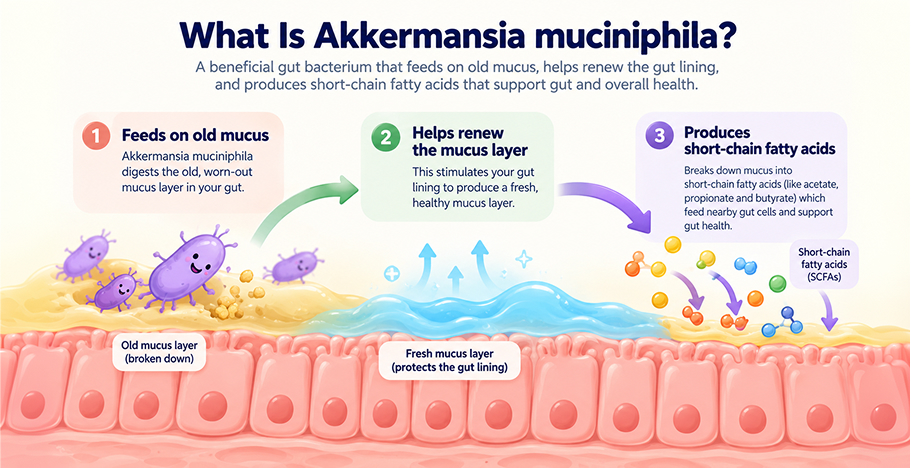
Akkermansia muciniphila is a gut bacterium that lives in the mucus layer lining your colon and feeds on mucin, the main protein in that mucus. First described in 2004, it usually makes up a small share of gut bacteria in healthy adults and is linked to a well-kept gut barrier.
Feeding on mucus sounds harmful, but in a healthy gut it is part of a cycle. The gut lining keeps renewing its mucus, and Akkermansia releases acetate and propionate, the short-chain fatty acids that feed other bacteria and gut cells.
It is one of the bacteria that make up a healthy Indian gut microbiome, alongside fibre-fermenters such as Prevotella and Faecalibacterium.
What Does Research Say About Akkermansia and Metabolism?
People with obesity and type 2 diabetes tend to carry less Akkermansia, and mouse studies link it to better blood sugar control and a stronger gut barrier. In humans the evidence is promising but limited, and it is not yet clear whether low Akkermansia causes these conditions or follows them.
The 2019 Supplement Trial
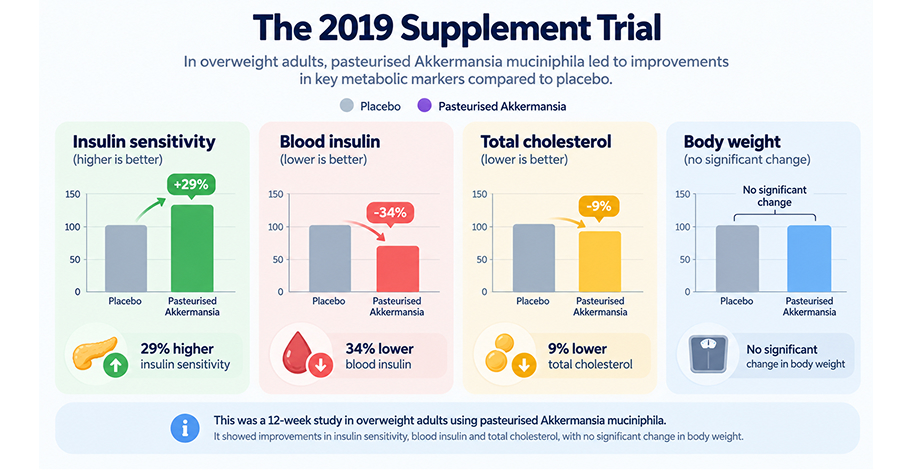
The best-known human study gave 32 overweight adults with insulin resistance a daily Akkermansia supplement or a placebo for three months. The pasteurised form improved insulin sensitivity by about 29% and lowered blood insulin and total cholesterol compared with placebo.
The trial, published in Nature Medicine, also saw small drops in weight and fat mass, but these were not statistically significant. The clearest results came from the heat-treated form rather than live bacteria, and with so few people it remains an early study.
For how gut bacteria relate to weight more broadly, read can a poor gut microbiome cause weight gain.
Why Did the Heat-Treated Form Work?
Heat-treated Akkermansiacannot grow in the gut, yet it still improved metabolism in mice and people. Researchers traced part of this to Amuc_1100, a protein on the bacterium's outer membrane that stays stable when heated and signals to gut cells, helping tighten the gut barrier.
Higher Starting Levels, Better Diet Results
In a French study of 49 adults on a six-week calorie-restricted diet, those who started with more Akkermansia saw bigger gains in insulin sensitivity and other health markers. This suggests your starting gut profile may shape how well a diet works for you.
How to Increase Akkermansia Naturally
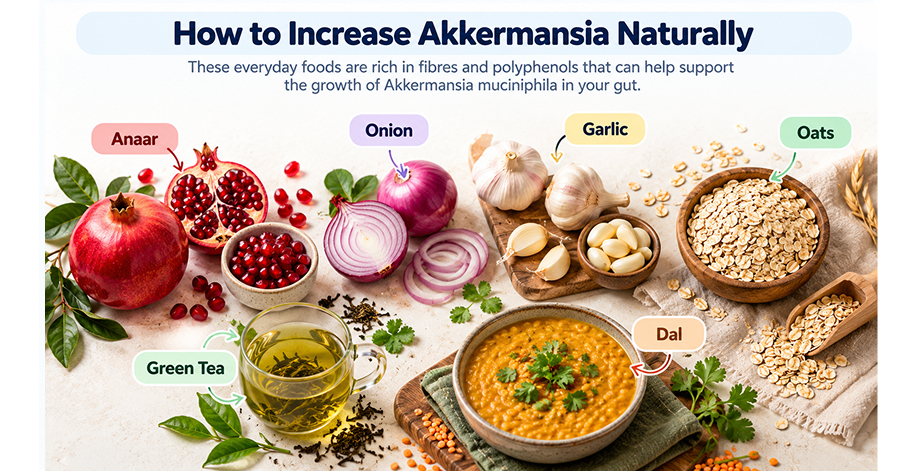
The most consistent ways to support Akkermansia are eating more fermentable fibre, adding polyphenol-rich foods and avoiding long stretches of low-fibre eating. Most of this evidence comes from animal studies plus a few small human trials, so treat these as sensible habits rather than proven boosters:
- Onion, Garlic, Oats and Whole Grains: Their inulin-type and other fermentable fibres raised Akkermansia in mouse studies and feed other helpful bacteria in people.
- Anaar (Pomegranate): In a four-week human study, people whose gut bacteria turned pomegranate compounds into urolithin A carried far more Akkermansia than those who did not.
- Green Tea and Grapes: Their polyphenols raised Akkermansia in animal studies. Amla and jamun are rich in similar compounds but have not been tested for this.
- Gaps Between Meals: A small Turkish study found Akkermansia rose during Ramadan fasting. Our guide to intermittent fasting covers how to do this safely.
Fibre matters most. In mice fed no fibre, mucus-eating bacteria, Akkermansia among them, wore down the gut's protective mucus layer. More Akkermansia is not automatically better if the rest of the diet starves your gut.
A home-cooked plate of dal, sabzi and roti with onion and garlic already covers several of these habits.
Do Fermented Foods or Probiotics Add Akkermansia?
No. Dahi, kanji and most probiotic capsules do not contain Akkermansia, because it is a strict anaerobe that struggles outside the low-oxygen gut. Fermented foods support gut health in other ways, but Akkermansia numbers grow from within, fed by the fibre and polyphenols you eat.
Does Metformin Affect Akkermansia?
Yes. People with type 2 diabetes who take metformin tend to carry more Akkermansia, and the drug boosts its growth in lab cultures. Researchers think part of metformin's effect on blood sugar works through gut bacteria. Never start or stop metformin for gut reasons without your doctor.
Should You Take an Akkermansia Supplement?
Probably not yet, unless your doctor suggests it. EU food regulators judged pasteurised Akkermansia safe as a food ingredient in 2021, but the evidence for benefit rests mainly on one small trial. Products differ in form and dose, and there is little Indian data.
Our look at what science says about probiotics explains why lab results often shrink in real life.
How Do You Know Your Akkermansia Level?
Only a stool-based gut microbiome test can show whether Akkermansia is present and roughly how much of it you carry. Levels vary widely between healthy people, so one number matters less than the overall pattern of diversity and fibre-fermenting bacteria in your gut.
Find out what lives in your gut. Bione's Gut Microbiome Test uses an at-home stool kit and 16S sequencing to map your gut bacteria. Your report includes a gut health score, foods to eat and limit, and a diet plan built around Indian foods. Book your test today.
Frequently Asked Questions
References
- Depommier et al. 2019, Nature Medicine
- Dao et al. 2016, Gut
- Plovier et al. 2017, Nature Medicine
- Li et al. 2015, Food & Function
- Wu et al. 2017, Nature Medicine
- de la Cuesta-Zuluaga et al. 2017, Diabetes Care
- Ozkul et al. 2019, Turkish Journal of Gastroenterology
- Desai et al. 2016, Cell
- EFSA 2021, Safety of pasteurised Akkermansia muciniphila
Medical disclaimer: This article is for general information only and does not replace advice from a qualified doctor or nutritionist.