
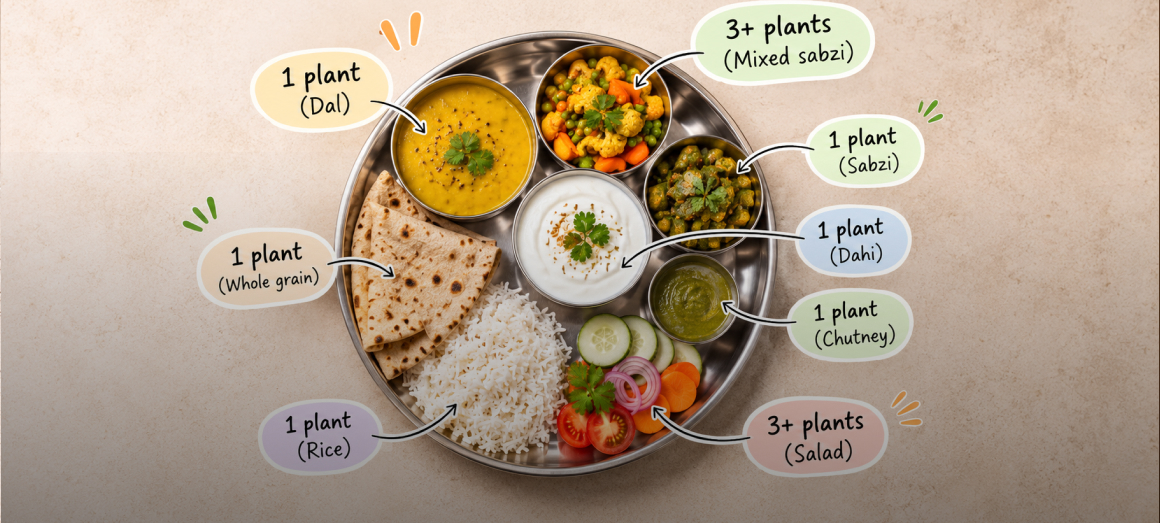
Social media's latest gut health trend, fibremaxxing, tells you to pile as much fibre as you can onto your plate. The research points somewhere more useful: your gut bacteria care more about how many different plants you eat than about the total grams of fibre.
A traditional Indian thali was built around that variety long before the trend arrived. This guide shows how each part of the thali feeds your gut, where modern Indian plates fall short, and how a gut microbiome test shows what your own gut bacteria need.
What Is the Best Indian Diet for Gut Health?
The best Indian diet for gut health is a home-cooked, plant-heavy thali: whole grains or millets, a full katori of dal, two or more vegetables, a bowl of yogurt and everyday spices. It feeds gut bacteria many kinds of fibre, while fermented foods add live bacteria.
This matches the Dietary Guidelines for Indians from ICMR-NIN. They say vegetables and fruits should fill about half the plate, at least half of cereals should be whole grains, and millets can make up 30 to 40% of cereals.
Our guide to fibre-rich foods lists everyday Indian sources for each part of the plate.
Why Plant Variety Matters More Than Fibre Volume
Different gut bacteria feed on different fibres and plant compounds, so a varied diet supports a wider range of species. In the American Gut Project, people who ate more than 30 plant types a week had more diverse gut bacteria than people who ate 10 or fewer.
That comparison, published in mSystems in 2018, looked at 41 people in the high-variety group and 44 in the low one. A diverse gut tends to be more stable and better at making short-chain fatty acids, which feed the cells lining your colon.
Indian guts are typically rich in Prevotella, a genus that feeds on plant fibre and is one feature of a healthy Indian gut microbiome.
How Many Plants Are on Your Thali?
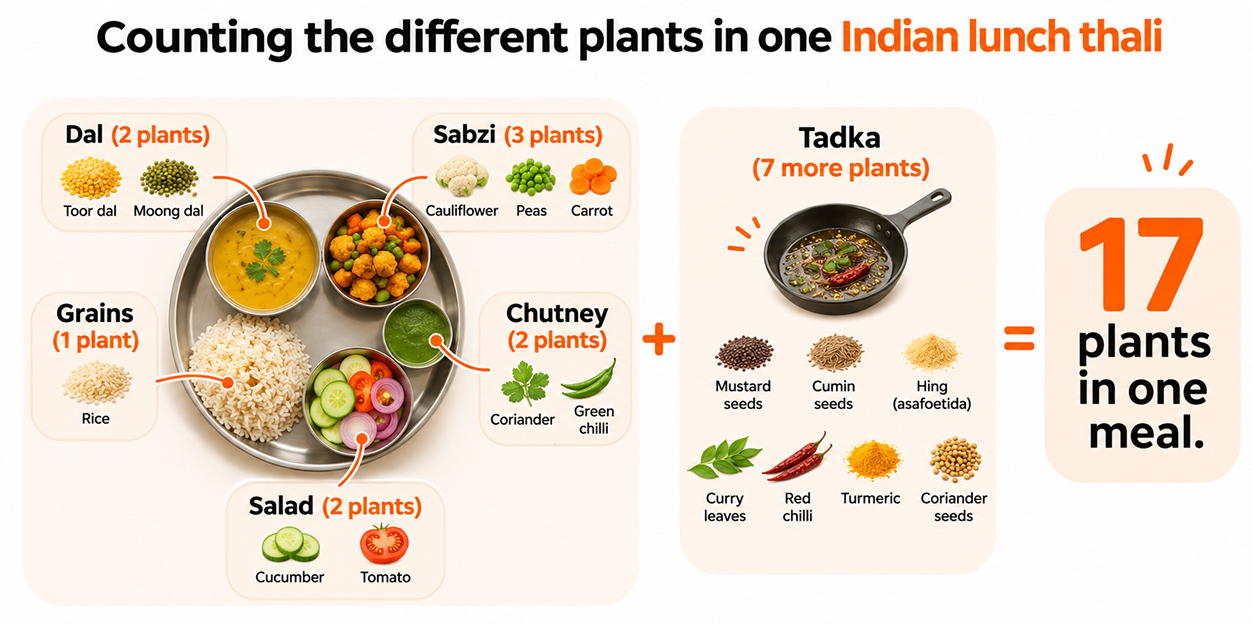
More than you might think. Count each different grain, dal, vegetable, fruit, nut and seed once a week, with herbs and spices on top. A simple home-cooked lunch thali often reaches ten plants before the tadka, so 30 a week is within easy reach.
- Grains: wheat in the roti and rice (2).
- Dal: toor dal (1).
- Sabzi and salad: bhindi, onion, tomato, cucumber and carrot (5).
- Chutney: coriander and mint (2).
- Tadka: jeera, haldi, hing, mustard seeds, garlic, ginger and green chilli (7 more).
Change the dal, sabzi and grain through the week and the count climbs quickly. A handful of peanuts, a seasonal fruit and a millet roti add more.
How Each Part of the Thali Feeds Your Gut
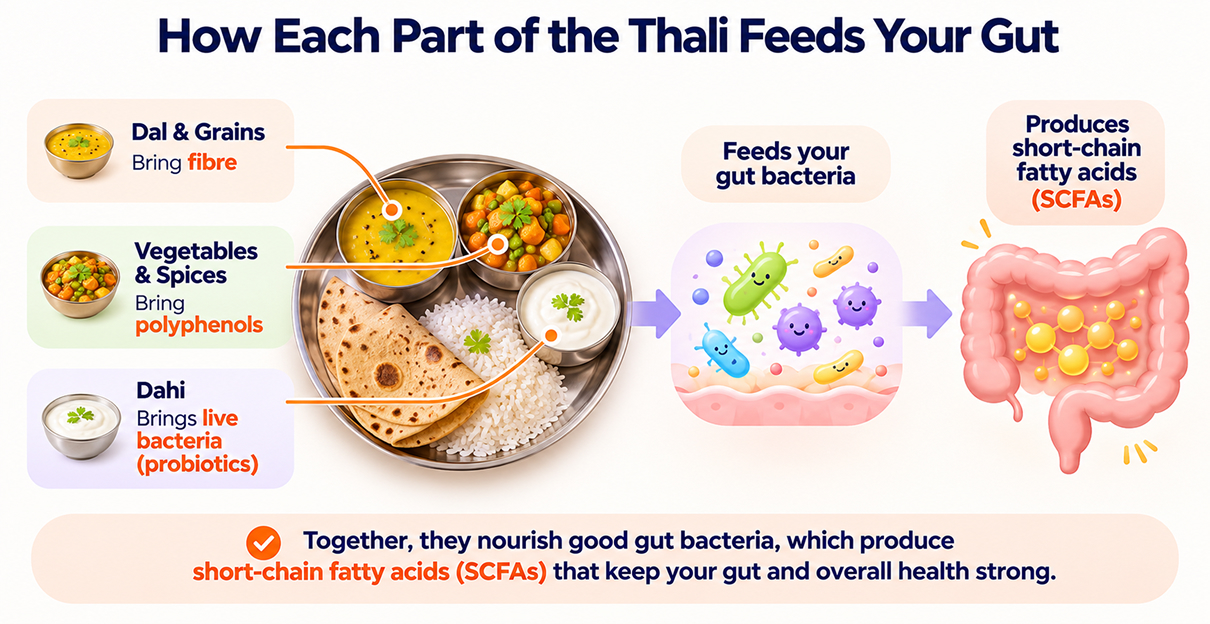
Each part does a different job. Dal and whole grains bring fibre and resistant starch, vegetables and spices bring polyphenols, and yogurt (dahi) brings live bacteria. Together they feed several groups of gut bacteria, which then make short-chain fatty acids that help protect the gut lining.
Dal, Rajma and Chana
Pulses are among the best gut foods in the Indian kitchen. They contain soluble fibre, resistant starch and sugars called galacto-oligosaccharides that reach the colon undigested, where bacteria ferment them. That fermentation is also why dal and rajma can cause gas in some people.
Soaking, pressure-cooking and a pinch of hing make pulses easier to digest. If dal regularly leaves you bloated, a low-FODMAP Indian diet can help you find your triggers, ideally with a dietitian.
Roti, Rice and Millets
Whole grains and millets feed gut bacteria better than refined ones, because the bran carries most of the fibre. Rotating wheat with ragi, jowar and bajra adds variety, and rice that is cooked and then cooled forms resistant starch, which bacteria turn into butyrate.
Brown rice, hand-pounded rice, dalia and a millet roti a few times a week are easy swaps that keep the grain part of the plate varied.
Sabzi, Salad and Fruit
Vegetables and fruit bring fibre plus polyphenols, plant compounds that gut bacteria break down into useful substances. For a 2,000-calorie day, the guidelines suggest about 400 g of vegetables and 100 g of fruit. Seasonal sabzi, leafy greens and whole fruit give the most variety.
Two different vegetables at each main meal, such as a dry sabzi and a leafy green, add plants with little effort. Methi, palak, lauki, bhindi, gajar and fruits such as guava and amla all count. Choose whole fruit over juice.
Yogurt, Chaas and Fermented Foods
Home-set yogurt, chaas and kanji contain live lactic acid bacteria. In a 10-week Stanford trial, people who ate more fermented foods had more diverse gut bacteria and lower levels of 19 inflammatory proteins, while a high-fibre diet alone kept diversity stable over that period.
Idli, dosa and dhokla are fermented too, but steaming and cooking kill most of their live bacteria. They are still light and easy to digest. Our list of fermented foods to add to your diet covers more Indian options.
Spices, Tadka and Ghee
Everyday spices may help in small ways. In a Penn State feeding study of 54 adults, a diet with about 6.6 g of mixed herbs and spices a day for four weeks raised Ruminococcaceae, a family of fibre-fermenting gut bacteria, compared with lower amounts.
The study was done in American adults at risk of heart disease, so it shows a direction rather than proof. A spoon of ghee also has a place, though most of the butyrate your colon uses is made by your own bacteria, as we explain in what your gut bacteria make.
Why Many Indian Plates Fall Short Today
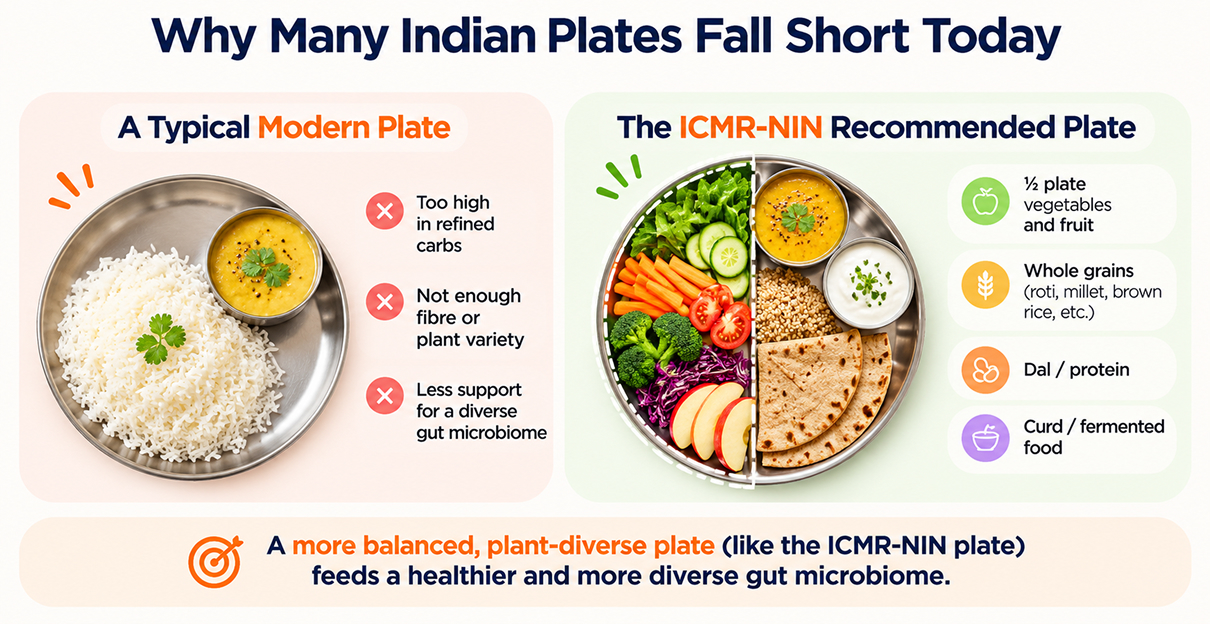
Many Indian meals today are heavy on rice or roti and light on dal, vegetables and fruit. In the ICMR-INDIAB survey of over 1.2 lakh adults, carbohydrates supplied about 62% of daily calories, much of it from white rice, milled grains and added sugar.
The same survey, published in Nature Medicine in 2025, found that protein made up only about 12% of daily energy. Packaged snacks, sugary drinks and frequent eating out push the plate further from the traditional thali.
Moving away from traditional food changes the gut too. A 2025 University of British Columbia study found that people living in India had guts rich in Prevotella, while Indo-Canadians had fewer of them. Ultra-processed food made up over 60% of Indo-Canadians' daily calories, against 12% in India.
The traditional plate is still cooked in most Indian homes, so the fix usually means eating more of what is already there.
How to Build a Gut-Friendly Indian Plate
Fill half your plate with vegetables, keep a full katori of dal, make at least half your grains whole or millet, and add yogurt once a day. Then rotate what you eat across the week, aiming for about 30 different plants, and keep packaged snacks and sugar low.
- Half the plate: two vegetables, or a sabzi plus salad, at lunch and dinner.
- A full katori of dal: or chana, rajma, sprouts, eggs or fish, since most Indian diets run short on protein.
- Grain swaps: a millet roti, brown or hand-pounded rice, or dalia a few times a week.
- Daily yogurt or chaas: plain and unsweetened, home-set if possible.
- Weekly rotation: change the dal, sabzi, fruit and grain so the plant count keeps climbing.
- Go slow: if you eat little fibre now, add it over two to three weeks and drink enough water to limit gas and bloating.
For more everyday options, see our guide to top gut-healing foods.
Does the Same Indian Diet Suit Everyone's Gut?
No. Two people can eat the same thali and get different results, because their gut bacteria differ. Some handle dal, onion or wheat easily, while others bloat. A gut microbiome test shows which bacteria you carry and which foods your gut may need more or less of.
If you have long-standing bloating, pain or a change in bowel habits, see a doctor first, since these can have causes beyond diet.
See what your thali is feeding. Bione's Gut Microbiome Test uses an at-home stool kit and 16S sequencing to map your gut bacteria. Your report includes a gut health score, foods to eat and limit, and a diet plan built around Indian foods. Book your test today.
Frequently Asked Questions
References
- McDonald et al. 2018, mSystems (American Gut Project)
- ICMR-NIN 2024: Dietary Guidelines for Indians
- Anjana et al. 2025, Nature Medicine (ICMR-INDIAB)
- D'Aloisio et al. 2025, npj Biofilms and Microbiomes
- Wastyk et al. 2021, Cell
- Petersen et al. 2022, The Journal of Nutrition
Medical disclaimer: This article is for general information only and does not replace advice from a qualified doctor or nutritionist.