
If your baby was born by C-section or needed antibiotics early on, you may have read that their gut has been harmed for life. The science is more reassuring than that, and it also points to simple things parents can do.
The question comes up in a lot of Indian homes. About one in five births in India is now a C-section, and in private hospitals it is close to half. This guide explains how birth, feeding and medicines shape a child's gut bacteria, what the research shows, and why a parent's own gut microbiome test can be part of the picture.
When Does a Child's Gut Microbiome Develop?
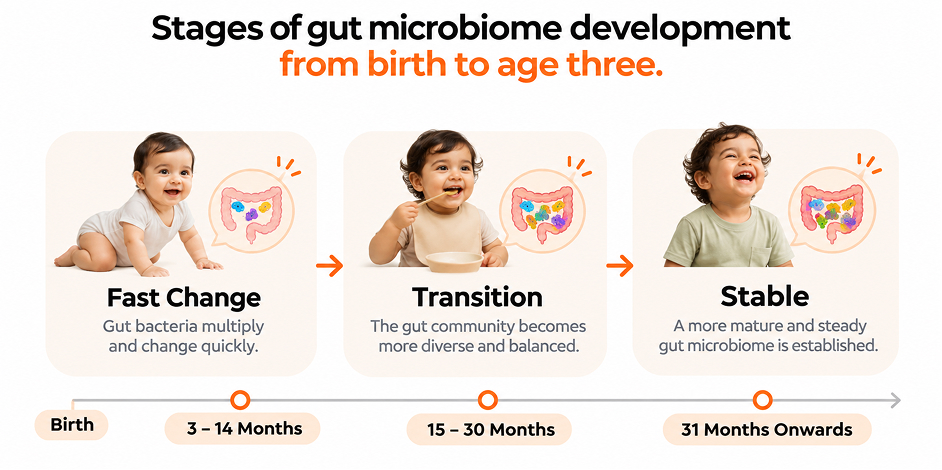
A child's gut microbiome builds up mainly in the first three years of life. It changes fastest between about 3 and 14 months, keeps shifting until around two and a half, and settles into a more stable, adult-like pattern by about age three.
Those stages come from a study that followed 903 children from 3 to 46 months, using over 12,000 stool samples. It is why doctors talk about the first 1,000 days, from pregnancy to the second birthday, as the period when birth, feeding and medicines leave the biggest mark.
By the time that window closes, a child's gut starts to resemble the healthy Indian gut microbiome seen in adults, shaped by the family's food.
Does a C-Section Affect a Baby's Gut?
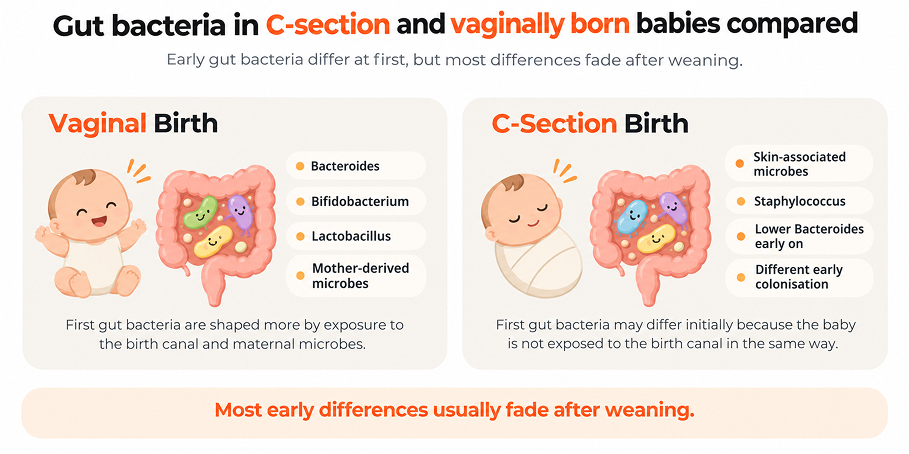
Yes, at first. Babies born by C-section miss contact with their mother's vaginal and gut bacteria during birth, so they start with fewer Bacteroides and more hospital-linked bacteria such as Enterococcus and Klebsiella. In a large UK study, most of these differences evened out after weaning.
That study, the Baby Biome Study, compared 314 vaginally born and 282 C-section babies. Its senior author noted that researchers do not yet know whether the early differences affect long-term health. A C-section is often the safest choice for mother and baby, and the gut catches up.
Should You Try Vaginal Seeding After a C-Section?
No, not outside a research study. Vaginal seeding means wiping a newborn with a swab soaked in the mother's vaginal fluid. The American College of Obstetricians and Gynecologists advises against it because the benefits are unproven and it can pass on infections the mother may not know she has.
Skin-to-skin contact soon after birth and starting breastfeeding early are safe ways to share a mother's bacteria with her baby, whatever the type of birth.
How Breastfeeding Shapes Your Baby's Gut
Breast milk contains special sugars called human milk oligosaccharides that babies cannot digest, but Bifidobacterium can. So breastfed babies tend to have guts rich in Bifidobacterium, which keeps the gut slightly acidic and less welcoming to harmful bacteria. The 903-child study linked breastfeeding to higher Bifidobacterium levels.
The WHO recommends exclusive breastfeeding for the first six months. In India, about 64% of babies under six months were exclusively breastfed in the last national survey (NFHS-5). If breastfeeding is not possible, a formula chosen with your paediatrician still lets your baby grow well; the gut simply develops along a slightly different path.
Early Antibiotics and Your Child's Gut
Antibiotics in the first years of life can lower diversity and slow its maturing. In a Finnish study of 142 children aged two to seven, repeated macrolide courses, such as azithromycin, were linked to long-lasting gut changes, higher BMI and more asthma. Needed courses are fine; unneeded ones add up.
- Most childhood colds, coughs and loose motions are viral: antibiotics do not help them, so ask your paediatrician whether one is needed.
- Never use leftover tablets or syrups: finish only what is prescribed, and do not reuse them for the next fever.
- Ask about probiotics: in children on antibiotics, probiotics lowered the chance of diarrhoea from about 19% to 8% in a Cochrane review.
Our guide to how long the gut takes to recover after antibiotics explains the recovery timeline in detail.
Why Your Child's Gut Matters for Growth and Immunity
The gut microbiome helps children digest food, absorb nutrients and train their immune system. In a study of children in Dhaka, undernourished children had gut bacteria that looked younger than their age, and short-term therapeutic feeding did not fix this, which suggests that gut maturity and healthy growth are linked.
Researchers are still working out how much gut bacteria affect height and bone development, a topic we cover in the link between gut health and bone growth. For the immune side, read our guide to boosting your child's immunity with proper nutrition.
How to Support Your Child's Gut Microbiome at Home
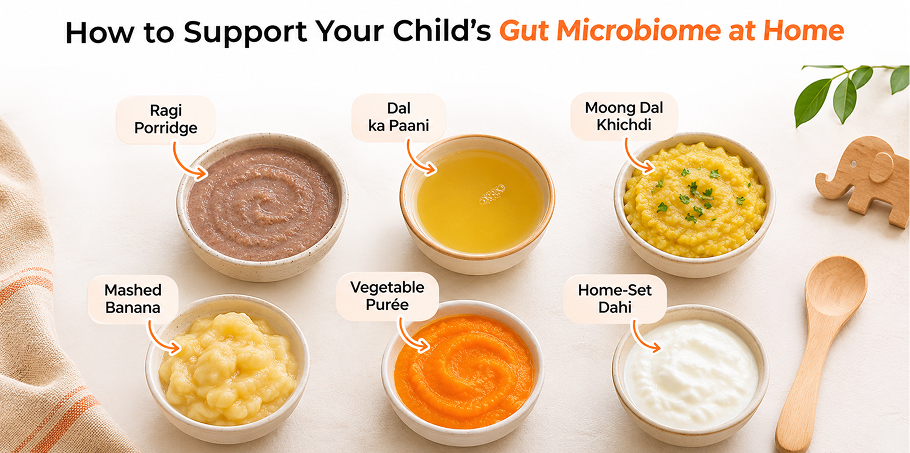
Start solid foods at six months with a wide variety of home-cooked foods, keep sugar and packaged snacks low, and let children play outdoors. A varied Indian diet gives growing gut bacteria many different fibres to feed on, which helps the community become diverse and stable.
- First foods from six months:ragi porridge, dal ka paani, then mashed dal, moong dal khichdi, mashed banana and vegetable purées.
- Variety each week: rotate rice, wheat, ragi and jowar, different dals, seasonal vegetables and fruits.
- Home-set dahi: add it once solids are going well, as your paediatrician advises. See our list of fermented foods to add to your diet.
- Less sugar and packaged food: avoid biscuits, packaged juices and added sugar in the first two years.
- Play, pets and people: children with older siblings, pets and time outdoors tend to have more varied gut bacteria, so there is no need to over-sanitise.
Can a Gut Test Help Your Family?
A mother's gut bacteria are among the first a baby receives, through birth, touch and feeding. Parents planning a baby, or with young children, can check their own gut health and improve it through diet. For concerns about your child's digestion or growth, start with your paediatrician.
Know the gut bacteria you pass on. Bione's Gut Microbiome Test uses an at-home stool kit and 16S sequencing to map your gut bacteria. Your report includes a gut health score, foods to eat and limit, and a diet plan built around Indian foods. Book your test today.
Frequently Asked Questions
References
- Shao et al. 2019, Nature (Baby Biome Study)
- Stewart et al. 2018, Nature (TEDDY study)
- Korpela et al. 2016, Nature Communications
- Subramanian et al. 2014, Nature
- ACOG 2017: guidance on vaginal seeding
- Cochrane review: probiotics for antibiotic-associated diarrhoea in children
- NFHS-5: C-section rates in India
- WHO: Breastfeeding
Medical disclaimer: This article is for general information only and does not replace advice from a qualified doctor or nutritionist.