
A five-day course of antibiotics can clear a chest or urinary infection. It also hits the trillions of bacteria in your gut that had nothing to do with the infection.
Most people recover, but not as quickly as they assume. This guide covers what antibiotics do to your gut, how long recovery really takes, where probiotics help and where they do not, and how a gut microbiome test can show whether your gut has recovered.
How Do Antibiotics Affect Your Gut?
Antibiotics cannot tell harmful bacteria from helpful ones, so a course also wipes out many gut bacteria. Diversity drops, fibre-fermenting groups such as Bifidobacterium and butyrate producers shrink, and hardier bacteria, some of them carrying resistance genes, briefly take over the space.
Broad-spectrum antibiotics, which act on many kinds of bacteria, usually cause more disruption than narrow-spectrum ones. The loss of butyrate makers matters because butyrate is the main fuel for colon cells.
Why This Matters in India
India uses antibiotics at a very large scale. A study in The Lancet Regional Health Southeast Asia counted about 5 billion daily doses sold through the private sector in 2019 alone, with azithromycin the most used. Many are bought without a prescription, despite rules such as Schedule H1.
Every unneeded course is a hit to your gut bacteria, and it also adds to antibiotic resistance.
How Long Does Gut Recovery Take After Antibiotics?
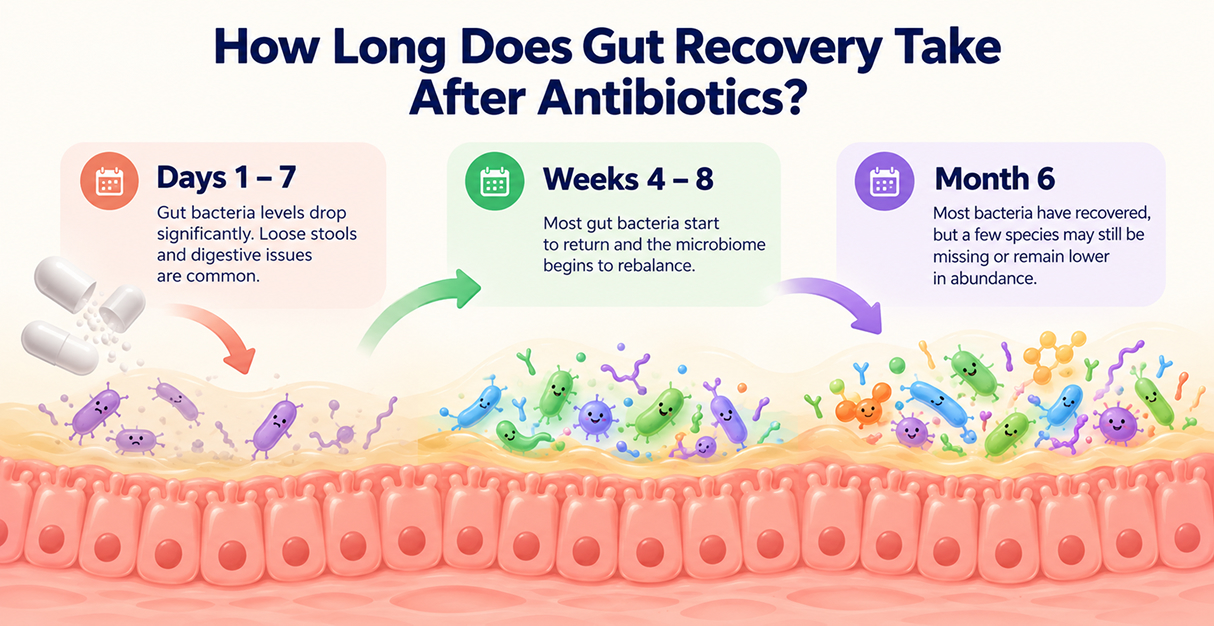
For most healthy adults, gut bacteria return close to normal within one to two months of a short course. Recovery is often incomplete, though. Some species can stay missing for six months or longer, and repeated courses give the gut less time to rebuild in between.
A 2018 study in Nature Microbiology gave 12 healthy men a four-day mix of three strong antibiotics. Their gut bacteria returned to near-normal within about six weeks, but nine common species were still undetectable in most of them at six months.
- First week: bacteria numbers fall sharply, and loose stools, gas or bloating are common.
- Four to eight weeks: most of the community grows back, helped by fibre and a varied diet.
- Six months and beyond: a few species may never return without new exposure from food and people around you.
A resilient, diverse gut recovers faster, which is one feature of a healthy Indian gut microbiome.
Signs Your Gut Is Still Recovering
Ongoing bloating, gas, loose or irregular stools and new trouble with foods you used to digest easily can all mean your gut bacteria have not fully recovered. These usually settle over a few weeks. If they persist, the imbalance may have turned into longer-term dysbiosis.
Our guide to dysbiosis covers the causes and how it is managed.
Do Probiotics Help After Antibiotics?
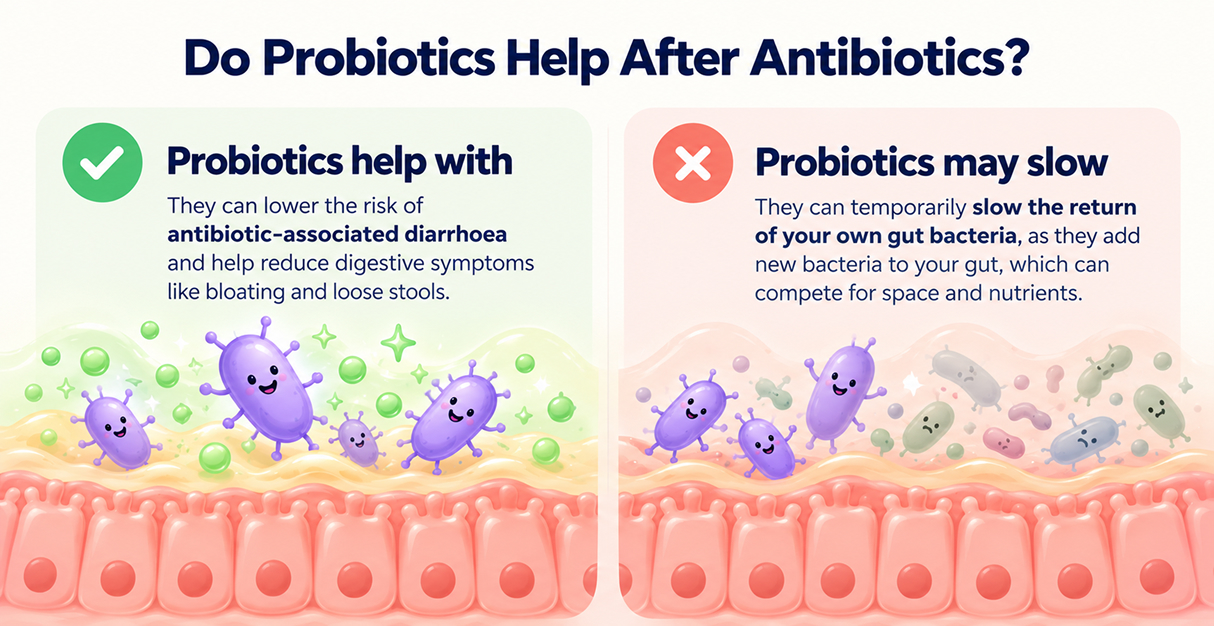
Probiotics help with one problem and may slow another. They lower the risk of diarrhoea during a course, especially in children, but a 2018 study found they can delay the return of your own gut bacteria. Whether to take one depends on your situation, so ask your doctor.
- Diarrhoea: in a Cochrane review of children on antibiotics, 8% of those given probiotics developed diarrhoea, against 19% without them.
- C. difficile: a Cochrane review found probiotics cut this serious gut infection from about 4% to 1.5% of people on antibiotics.
- Slower recovery: in the 2018 study published in Cell, people who took a multi-strain probiotic after antibiotics still had not regained their usual gut bacteria after five months.
If your doctor suggests one, Lactobacillus rhamnosus GG and Saccharomyces boulardii have the most evidence. Space bacterial probiotics a few hours away from antibiotic doses. For a broader look, read what science says about probiotics.
What to Eat to Restore Your Gut After Antibiotics
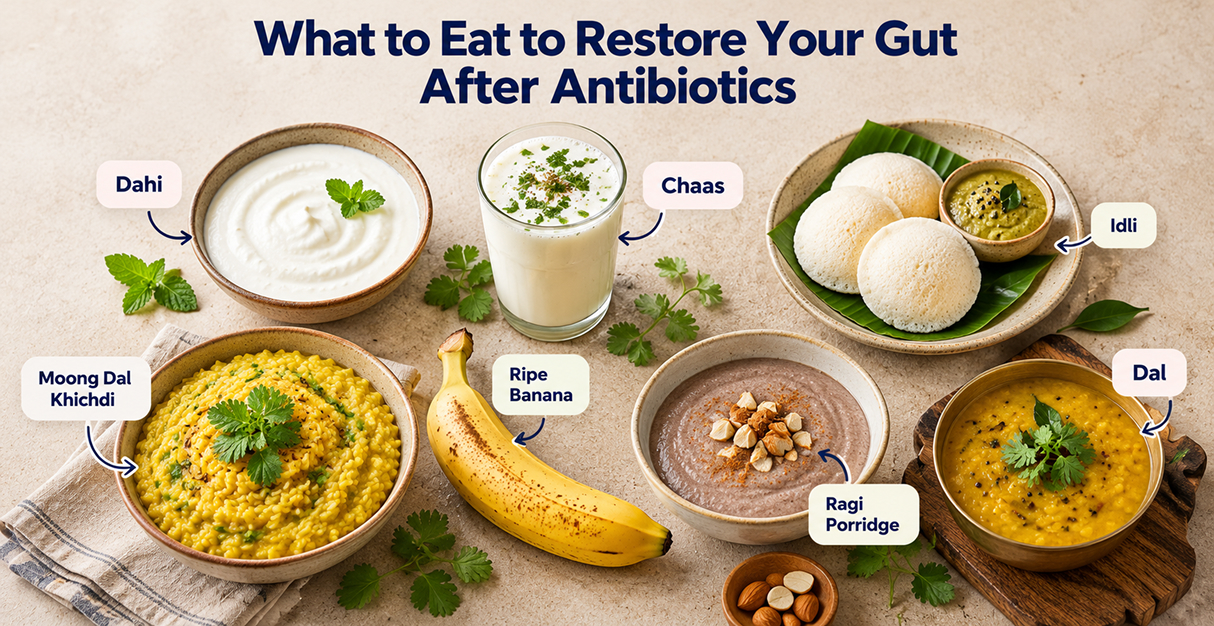
Fibre and fermented foods give returning gut bacteria what they need to grow back. In mice, a low-fibre diet slowed recovery after antibiotics, and in a human trial, eating more fermented foods raised gut diversity within ten weeks. Start gently while your stomach is upset, then widen the variety.
- Dahi and chaas: they bring live bacteria, but keep them two hours apart from antibiotics such as doxycycline or ciprofloxacin, since calcium can block their absorption.
- Idli, dosa and dhokla: fermented and easy on an upset stomach.
- Moong dal khichdi: gentle in the first few days, with fibre from the dal.
- Dals, millets and vegetables: add these back as your stomach settles, aiming for many different plants across the week.
- Ripe banana, then raw banana and cooled rice: ripe banana is gentle; the resistant starch in raw banana and cooled rice later feeds butyrate makers.
Our list of fermented foods to add to your diet has more Indian options.
How to Protect Your Gut Next Time You Need Antibiotics
The best protection is avoiding courses you do not need. Most colds, coughs and viral fevers do not need antibiotics. When you do need one, take it exactly as prescribed, and never self-medicate, reuse leftover tablets or share them with family members.
Ask your doctor whether a narrow-spectrum option will work, and tell them about any past antibiotic diarrhoea.
Can a Test Show If Your Gut Has Recovered?
Yes. A gut microbiome test taken two to three months after a course shows how diverse your gut is and whether key groups such as butyrate producers have returned. It helps you decide whether your diet needs more fibre, fermented foods or variety to finish the recovery.
Check whether your gut has recovered. Bione's Gut Microbiome Test uses an at-home stool kit and 16S sequencing to map your gut bacteria. Your report includes a gut health score, foods to eat and limit, and a diet plan built around Indian foods. Book your test today.
Frequently Asked Questions
References
- Palleja et al. 2018, Nature Microbiology
- Suez et al. 2018, Cell
- Ng et al. 2019, Cell Host & Microbe
- Wastyk et al. 2021, Cell
- Cochrane review: probiotics for antibiotic-associated diarrhoea in children
- Cochrane review: probiotics for C. difficile diarrhoea
- Consumption of systemic antibiotics in India in 2019, Lancet Regional Health Southeast Asia
Medical disclaimer: This article is for general information only and does not replace advice from a qualified doctor or nutritionist.